
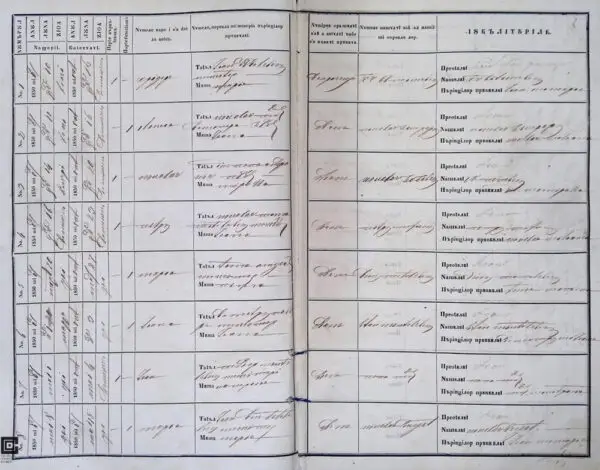
To locate birth, marriage, or death records in Romania:
- Identify details (exact year, locality, and event type).
- Check the location – either the county branch of the National Archives or a local town hall.
- Account for history – use historical administrative boundaries.
- Pre-registration dates – search parish registers (before 1865 in the Kingdom, 1895 in Transylvania).
Looking for Vital Records in the Romanian Archives?
Civil status documents form the cornerstone of genealogical research, providing essential details to uncover family histories.
In Romania, vital records (birth, marriage, and death documents) are preserved either by the county branches of the National Archives (Serviciile Județene ale Arhivelor Naționale) or by local town halls (primării).
Understanding how these archives are organised and how Romania’s administrative boundaries have changed over time is crucial to a successful search. This guide offers a step-by-step method, illustrated with real archival examples, to help you navigate the system efficiently. While our focus is on birth records, the same principles apply to marriage and death records as well.
1. Establish a Clear Starting Point
The first step in genealogical research is to begin with the most recent verifiable information about the person or family line you are studying. This may be a documented birth date, marriage record, or death certificate, ideally confirmed through reliable sources.
Before searching in Romanian archives, you should:
- Compile all known data about the individual(s) you are researching.
- Identify the specific document you need (birth, marriage, death, military file, church register, etc.).
- Determine which type of archive is likely to hold the record.
Important: Archival sources in Romania are dispersed across multiple fonds (fonduri), so there is no single, centralised repository for all genealogical data. The type of record determines the archival fond, and the fond determines the location of the search.
Administrative evolution matters. Over time, many communes (comune) were abolished, merged, or reassigned to different counties (județe). Understanding historical administrative boundaries is essential to locating the correct archive.
Example – Why a Birth Certificate Is Not Enough
Researchers often rely on a relative’s birth certificate to find older records, only to come up empty-handed. The issue is that the certificate is a secondary document summarising the original civil status record (act de stare civilă), which contains far more detail: the exact village or hamlet of birth, the commune at the time, witnesses, and the registrar’s name.
If you search using the issuing locality (where the certificate was provided) instead of the recording locality (where the event occurred), you risk looking in the wrong archive. This is especially important in Romania due to frequent administrative reorganisations.
Civil Status Record vs. Civil Status Certificate
In Romania:
- Civil status record (act de stare civilă) – the original entry created at the time of the event. Held at the local town hall for around 100 years before being transferred to the National Archives.
- Civil status certificate (certificat de stare civilă) – an official extract or copy issued upon request to entitled individuals.
For genealogical research, the record is the primary source, containing richer details than the certificate.
2. Identify the Correct Archive, Fond, and Collection
Once you know what record you need, the next step is to determine where it is stored.
Before visiting an archive:
- Review the archive’s website and any available online inventories.
- Contact the county branch of the National Archives for confirmation.
- Check historical administrative directories for the relevant period.
Key data required for identification:
- Year or approximate period of the event.
- Exact locality where the event was recorded.
- Administrative affiliation of the locality at the time of the event and at the time the record was transferred.
Example – Administrative Reorganisation
Băcești commune was part of Roman County during the 19th and early 20th centuries. Later, it came under Vaslui County. Roman County was abolished, and its territory was split between Neamț and Vaslui counties.
- Records before 1878: Neamț County Archives.
- Records after 1878: Vaslui County Archives.
The year of the document determines the relevant archive, even if the locality’s name remains unchanged.
3. Follow a Methodical Research Process
Genealogical research in Romanian archives requires patience and a step-by-step strategy:
- Identify a clear starting ancestor or family branch.
- Analyse each record thoroughly.
- Gradually build connections between generations.
Details to watch for:
- Ages may be approximate—variations between records are common.
- Names may change due to spelling, adoption, or administrative reasons.
Example – One Person, Three Names
Ion Păun Teodorescu (born 1879) was adopted by his relatives, Maria and Ion Toma Bunget. In marriage and his children’s birth records, he appeared as Ion Tomescu. Some military documents listed him as Ion Bunget. His 1959 death record named him Ion Bunget. The correct lineage was proven by cross-referencing multiple records.
4. Understand Historical Civil Registration in Romania
- 1865 – Civil registration was introduced in the Kingdom of Romania (Wallachia and Moldavia).
- 1895 – Civil registration was introduced in Transylvania.
- Before these dates: records kept by parishes (registre parohiale), known as the Mitrice Collection.
To find pre-registration records, you must know the parish and religious affiliation.
Post-Civil Registration Procedures
- Records are organised by year and locality.
- Urban areas have large volumes—indexes are essential.
- Rural areas often lack indexes, requiring manual file checks.
Language & script notes:
- Pre-1865 records: Romanian in Cyrillic script.
- The first years after 1865: mixed Cyrillic and Latin.
- Transylvania: Hungarian post-1895; earlier records may be in Hungarian, German, or Romanian.
5. Restrictions and Access Rules
- Civil status records younger than 100 years are restricted and must be requested from the issuing town hall.
- Older records are usually transferred to the county branch of the National Archives, though the transfer date varies.
6. Record and Analyse Your Findings
Document your research process:
- List fonds and files consulted.
- Summarise findings with dates, names, ages, occupations, and relationships.
- Note witnesses—they can reveal extended family connections.
7. Continue Expanding Your Family Tree
Once you find one generation’s records, use them to locate earlier ones—marriage records for parents, then their birth records, and so on. Approach each step systematically and respectfully, especially when contacting potential relatives.
Researching vital records in the Romanian Archives can be a rewarding but meticulous process. Understanding the distinction between certificates and original records, knowing Romania’s administrative history, and following a structured search method will save time and lead to more accurate results.
Trace Your Romanian Roots with Expert Help
Searching for your ancestors in Romania can be challenging, especially with scattered records, historical administrative changes, and old scripts in Romanian, Hungarian, or Cyrillic. Our research centre specialises in genealogy and archival investigations across all Romanian counties. You don’t need to wait until your next vacation or spend endless hours sifting through old, difficult documents.
We can:
- Identify the right archives and locate original records.
- Interpret historical documents and translate old scripts.
- Build complete family trees based on verified sources.
- Provide copies or scans of original records.
Whether you have just a name and a date or a family story passed down through generations, we can turn clues into documented history.
Contact us today to start your search and uncover the stories of your Romanian ancestors.

